
























































 ΔΕΙΤΕ ΠΡΩΤΟΙ ΟΛΑ ΤΑ ΝΕΑ ΤΟΥ TRIBUNE ΣΤΟ GOOGLE NEWS
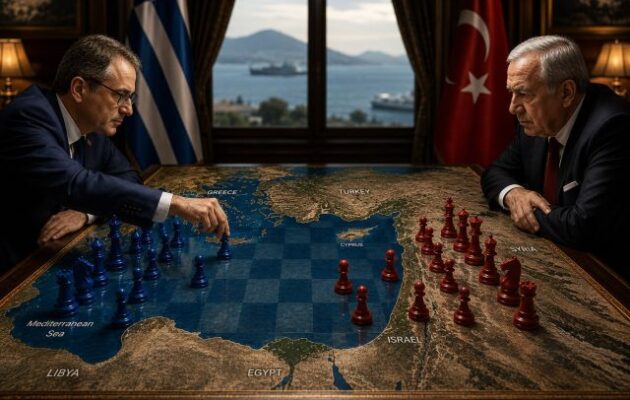
The recent NATO Summit demonstrated, in the clearest possible terms, the limits of Greece’s strategy toward Turkey.
While Athens continues to invest in the image of a predictable and consistent ally, Ankara methodically leverages its geopolitical advantages, converting them into bargaining power and strategic concessions.
If Greek foreign policy fails to readjust its doctrine to the new international realities, it risks finding itself strategically cornered within a Western security architecture shaped without its meaningful influence.
Geopolitical “Real Estate” and Trump
Turkey has long operated on the international stage in terms of geopolitical real estate. It does not sell allied loyalty or shared values; it sells geography, access, and strategic utility. It sells control of the Straits, Europe’s southeastern flank, and access to the Middle East and the Black Sea.
And currently, there is an interlocutor in Washington who perceives international relations primarily through a transactional lens. Donald Trump views security in terms of cost and benefit. From this perspective, Turkey appears as a regional player with a large standing army, a vital geographic position, and the capacity to shoulder part of the burden of regional security, thereby allowing the United States to reallocate its resources and priorities.
The Three Fatal Flaws of Greek Strategy
1. The Downplaying of the Threat
The use of terms like “sensitivities” and “concerns” downplays the gravity of the issues. The casus belli and the potential upgrade of Turkish military capabilities are not matters of psychology or symbolism; they directly affect Greece’s national security.
When a country itself does not define a danger as a security threat, its allies can hardly be expected to do so.
2. The “Disappearance” of Cyprus
The systematic decoupling of the Cyprus issue from broader discussions on European and NATO security constitutes a strategic blunder. The presence of an occupying army on European soil cannot be treated as a secondary issue simply because the Republic of Cyprus is not a NATO member. Greece and Cyprus must constantly remind the world that the principles of International Law cannot be applied selectively.
3. The “Taken-for-Granted” Syndrome
When a country provides critical strategic facilities without seeking corresponding political and geopolitical returns, it risks being taken for granted. Allies rarely expend political capital on those they consider certainties; they typically invest it where there is cost, uncertainty, or high stakes.
Thinking Out of the Box: Choke Point Diplomacy
Greece must seek opportunities beyond traditional NATO frameworks. It requires a broader network of strategic anchors based on economic diplomacy, shipping, investment, and geo-economic influence.
The Horn of Africa is a case in point. This region controls access to the Red Sea and the Suez Canal—one of the world’s most critical trade corridors and a vital space for Greek shipping interests.
For a nation with Greece’s maritime tradition and economic footprint, enhancing its presence in this region is not a luxury; it is a strategic necessity.
In this context, Athens must develop a multi-layered network of contacts and partnerships with all actors influencing stability, maritime security, and the operation of critical port infrastructure in the area.
This approach requires neither political recognition nor a shift in Greece’s long-standing positions in favor of International Law, state sovereignty, and territorial integrity.
Instead, it can be driven by the tools of economic diplomacy, maritime investments, technical cooperation, development programs, and participation in infrastructure projects that enhance regional connectivity and security.
Greece possesses a comparative advantage that remains largely untapped: the ability to link its maritime economic power with its geopolitical presence.
Through targeted initiatives in ports, commercial networks, and energy and transport corridors, Greece can secure a substantial strategic footprint in a region of growing global importance. It can achieve this without creating unnecessary friction with partners and allies, and without providing pretexts to those attempting unfounded parallels with other regional conflicts.
Control and influence over critical arteries of global trade are not achieved solely through military might or formal alliances.
They are secured through economic presence, investment penetration, and strategic consistency. In the 21st century, influence does not flow from military power alone; it stems from a state’s ability to render itself indispensable to the designs of others.
The Doctrine of Unified Hellenism as a Common Front of Power
Athens must adopt a new diplomatic doctrine based on three pillars:
Establishment of a Unified Geostrategic Space: Greece and Cyprus must be treated as interdependent pillars of security in the Eastern Mediterranean. The security of Nicosia is an integral part of the security of Athens.
Persistent Elevation of the Cyprus Issue: Greece and Cyprus must continuously remind the international community that the presence of foreign occupying troops on European territory remains an open issue of international legality and security.
The Policy of Leverage (The Cost Policy): Greek consensus on critical NATO and European priorities cannot be taken for granted. The country’s geopolitical value must be translated into tangible strategic and political benefits.
The era when credibility alone sufficed to secure leverage has passed. In today’s international environment, consistency remains necessary, but it does not dictate developments.
Greece does not need a diplomacy of grievances. It needs a diplomacy of power. In international politics, no one respects the player who is taken for granted; respect is reserved for the one who can affect the cost of choices.
Respect is not solicited; it is compelled.






 Για έγκυρη ενημέρωση πατήστε follow και ακολουθήστε μας στο twitter